Introduction
Let’s set up an Arch Linux VM on a Ubuntu 24.04 host system.
There is great material out there, e.g. this guide on installing Arch Linux, but I was missing small pieces here and there. Hence this post.
Install Virtualbox
One tool to manage virtual machines is Virtualbox. To install it run
sudo apt install virtualbox
For a more detailed guide please see this page.
Now if you enter
virtualbox -h
in your terminal you should see something like

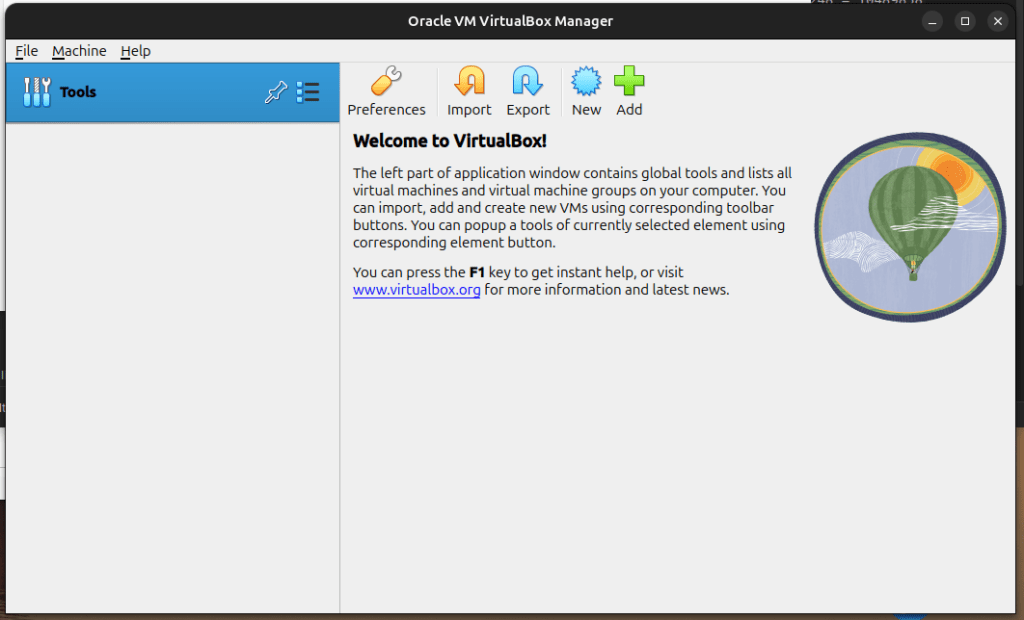
This also means you should be able to start the graphical user interface
Download The ISO Image
Go to https://archlinux.org/download/ to download the torrent file

which should show up as something like archlinux-2024.10.01-x86_64.iso.torrent in your ~/Downloads folder.
In order to download the iso install qbittorrent via
sudo apt install qbittorrent
Now you should be able to double click the archlinux-2024.10.01-x86_64.iso.torrent file, starting the qbittorrent graphical user interface. Once your download is completed you should have the file archlinux-2024.10.01-x86_64.iso in ~/Downloads. Now you can terminate qbittorrent as we won’t be needing it anymore.
Create The Arch Linux VM
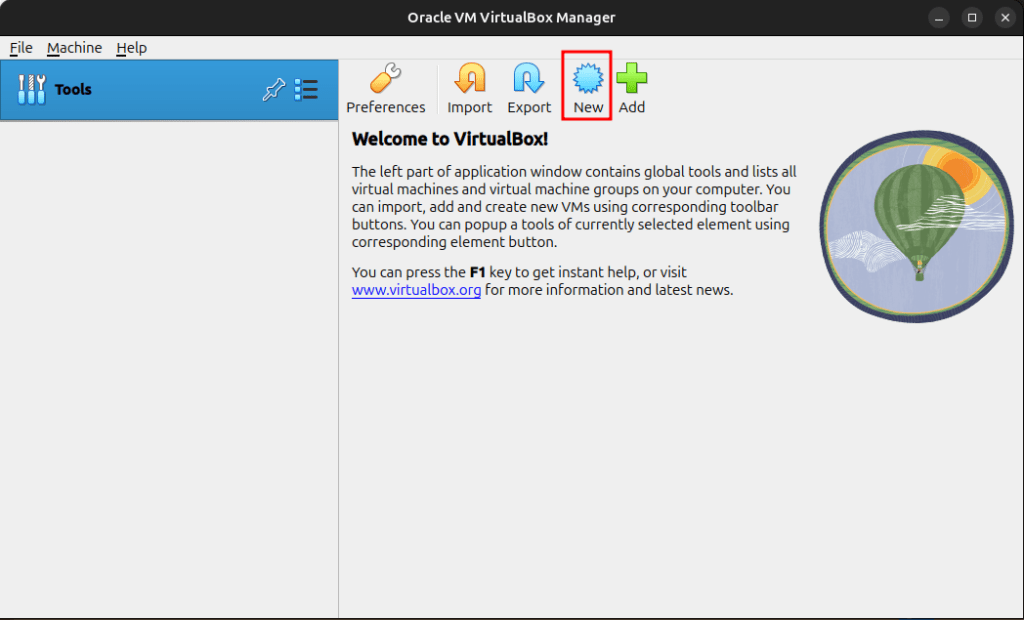
Start the virtualbox app and click “New”
Select the the archlinux-2024.10.01-x86_64.iso file and choose a name for your VM, I’ll call it “archie”

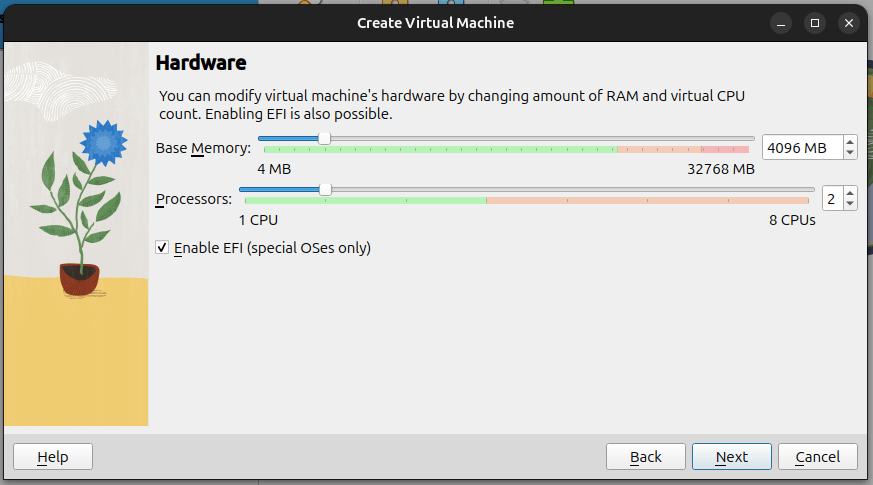
Select the compute hardware specs and tick the “Enable EFI” box
Set the storage hardware specs

Configure The Arch Linux Guest OS
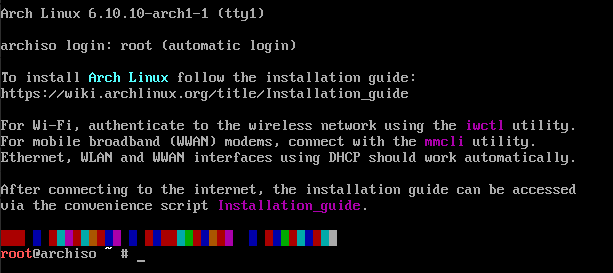
Now the image should be created. Time to start it and set up the guest OS.

After clicking “Start, a new window will open, you will see 3-4 startup options and a count down, select the first one or just let the counter run out.
Keyboard layout
Now we follow the steps in this guide on installing Arch Linux from 1.5 Set the console keyboard layout and font onwards (only relevant if your keyboard layout is a non-US layout). To list the keymap run
localectl list-keymaps
This seems to enter a vi editor ( basic commands) by default. To quit the editor enter :q. To set the keymap run
loadkeys YOURKEYMAP
Boot mode
Enter
cat /sys/firmware/efi/fw_platform_size
mainly to check 1) if the efi/ directory is present (if not you forgot to tick “Enable EFI” in the virtualbox interface (see above). If the directory is present you should get 64 returned and all is good.
Internet sanity check
Do we have internet access? Run
ping archlinux.org
should show something like

and interrupt it at some point with CTRL + C after a few packages were sent, I lost patience at 3 evidently.
Check the time
Run
timedatectl
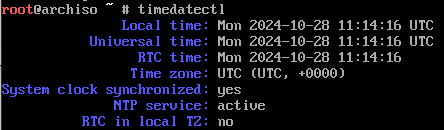
In my case the time zone is off but the rest is fine. To get the available commands run
timedatectl -h
In my case I want run
timedatectl set-timezone MYZONE/MYCITY
Available values for MYZONE and MYCITY can be found through entering one letter after the other and the Tab key, e.g. producing Europe/London `.
Disk business overview
We want to assign parts of our hard drive reserved for this image to partitions and tell the Arch OS where it can find what.
What we are going to do is create three partitions, assign their types and mount them. The relevant tools are: fdisk, lsblk, mkfs, mwswap, mount and swapon.
In the following table you can see what our setup will look like once we stepped through the upcoming commands
Order created in with fdiskPartition typeDevice identifierSizeFile System TypeMount pointfdisk Start Sectorfdisk End Sector1EFI system partition/dev/sda11 GBFAT32/boot204820992022Linux swap/dev/sda24 GBSwapswap2101248104898583Linux root/dev/sda359 GB (rest)ext4/10491904134217727
During disk partitioning with fdisk you will be asked from which start sector to which end sector the partition should stretch. A sector, turns out, is span of 512 bytes. So based on this helpful StackExchange post the logic is as follow
(n_hd * 1024**3 + n_swap * 1024) / 512 + start sector = end sector
So if we want to assign a partition of size 3 GB we would use n_hd = 3 and n_swap = 1 (unless we feel like assigning for for the swap header). The start sector will be suggested to us by fdisk during execution. A full example:
(1 * 1024**3 + 1 * 1024) / 512 + 2048 = 6293506
So our 3GB + 1KB partition would start at sector 2028 and end at 6293506.
Alright let’s do it!
Partitioning the disk
When you run
fdisk -l
you should see something like
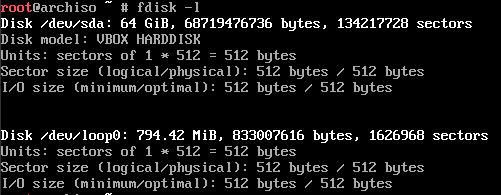
We will use the device /dev/sda. In case you are curios (what that stands for see here and here) and ignore /dev/loop0.
So let’s start partitioning by running
fdisk /dev/sda
The first partition we want to create is our 1GB EFI system partition.
Type: n, enter, enter, enter, 2099202
The number can be obtained using our logic from above, we calculate the end sector (1 * 1024**3 + 1 * 1024) / 512 + 2048 = 2099202

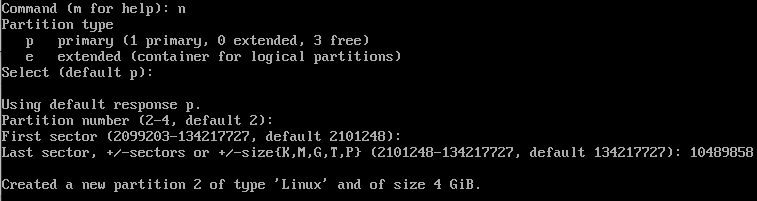
Onto the 4GB sized swap partition.
Type: n, enter, enter, enter, 10489858
The number of the end sector is obtained using (4 * 1024**3 + 1 * 1024) / 512 + 2101248 = 10489858
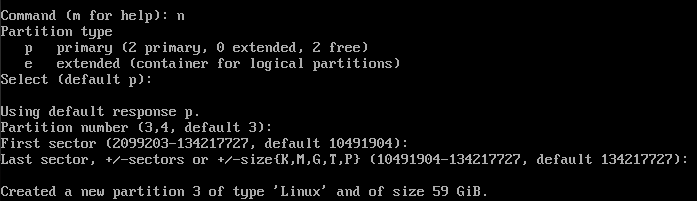
Lastly to our 59GB root partition.
Type: n, enter, enter, enter, enter
Here we don’t need to calcualte the final sector because we just fill up the remaining sectors with out partition.
You are not done!
Type w and press enter to write the table to disk. If you quit without doing that the table you have created is discarded.
To sanity check run
fdisk -l
and you should see something like
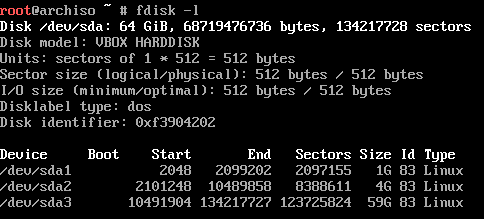
If you do not you forgot the w at the end of the fdisk process. But if that happens to you, know the pain is shared.
Formatting The Partitions
Next let’s assign the partition types
First the ext4 type to the root partition (/dev/sda3)
mkfs.ext4 /dev/sda3
then swap to the erm swap partition (/dev/sda2)
mkswap /dev/sda2
and finally FAT32 to the EFI partition (/dev/sda1)
mkfs.fat -F 32 /dev/sda1
Mount The Partitions
Now let’s mount the partitions using
mount /dev/sda3 /mnt
mount --mkdir /dev/sda1 /mnt/boot
swapon /dev/sda2
Install Packages
Now let’s install some helpful packages
pacstrap -K /mnt base linux linux-firmware
Note that this will download ~530MB and may take a few minutes to install after the download.
Configuring The Install
Time to
genfstab -U /mnt >> /mnt/etc/fstab
Change the root dir
arch-chroot /mnt
Symbolically link the timezone config
ln -sf /usr/share/zoneinfo/Europe/London /etc/localtime
Set the clock
hwclock --systohc
To set the locale you need a text editor. I prefer vim. So let’s install it. The next lines are a rough guide on what to do to set the US UTF-8 locale.
First install vim with
pacman -S vim
Then use vim to edit
vim /etc/locale.gen
Witihin vim search for “en” by typing
/en + enter
Then switch to insert mode by typing
i
With normal key bindings delete the # in front of en_US.UTF-8 UTF-8. And leave the insert mode using
ctrl + c
To save and exit run
:x + enter
Now run the locale generator using
locale-gen
Write to the locale.conf file using echo "LANG=en_US.UTF-8 >> /etc/locale.conf
Check that the file contains the line we just passed with head /etc/locale.conf
After the locale bit is done let’s do some more random things
echo "KEYMAP=us" >> /etc/vconsole.conf
To check run head /etc/vconsole.conf.
To name your host run echo "YOURFUNKYNAME" >> /etc/hostname
Sometimes running mkinitcpio -P (will take a moment) helps, although apparently not required.
Let’s set the root password so we can log in after the upcoming reboot using
passwd
Boot Loader
Almost done. Now we need to tell the boot loader how to trigger our Arch setup.
First install the efibootmgr tool using
pacman -S efibootmgr
For what’s next we need to know the root UUID. To get the root UUID run head -n 10 /etc/fstab and select the value for /dev/sda3.
Now check presence of vmlinuz-linux and initramfs-linux.img using ls /boot/.
Then let’s create the bootloader entry using
efibootmgr --create --disk /dev/sda --part 1 --label "My Arch Linux Boot Option" --loader /vmlinuz-linux --unicode 'root=UUID=YOURSDA3UUID rw initrd=\initramfs-linux.img'
Now, suddenly, we are pretty much all done. :-P Enter exit or ctrl + d to leave chroot environment.
Detaching
To verify if we can detach the partitions run
umount -R /mnt
If that was successful run
reboot
Now the vm machine should reboot.
Logging in
If everything worked out correctly you should see the following after the reboot
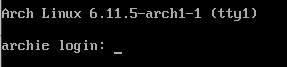
Here enter root and then use the root password you’ve set above. If that worked you should see the glorious

Conclusion
Kid: How do you know someone uses Arch Linux?
Dad: They will tell you.
Welcome to the “they”! :-)